
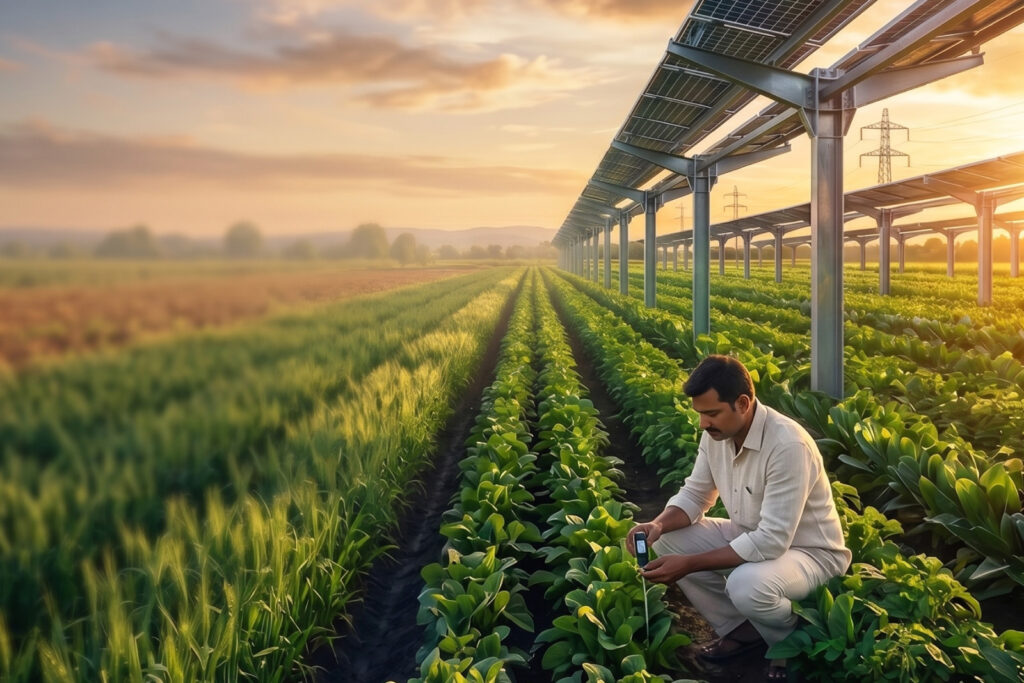
At first glance, agrivoltaics may seem simple—install solar panels above farmland and generate clean energy alongside crops. But this oversimplification misses the point. Agrivoltaics is not just “solar above farms.” It is a carefully engineered system where agriculture and energy are designed to work together, not compete.
The Problem with the Simplistic View
Traditional solar farms often require large land areas, sometimes displacing agricultural activity. Agrivoltaics challenges this by proposing dual-use land. However, simply placing panels over crops without proper design can lead to:
- Reduced crop yields due to excessive shading
- Inefficient solar generation
- Poor water and microclimate management
- Operational challenges for farming equipment
In other words, without the right approach, agrivoltaics can fail both as a solar project and an agricultural system.
Agrivoltaics Is a Design Challenge
Successful agrivoltaics depends on balancing multiple variables simultaneously:
- Crop type and light requirements
- Solar irradiation and panel orientation
- Height and spacing of structures
- Water usage and irrigation patterns
- Local climate and soil conditions
Each decision affects both energy output and agricultural productivity. This makes agrivoltaics a multi-disciplinary design problem, not just an installation exercise.
The Role of Intelligence and Modelling
What differentiates true agrivoltaic systems is the use of data and simulation before execution.
Advanced modelling helps answer critical questions:
- How much light will reach the crops at different times of the day?
- What is the optimal panel height and spacing?
- How will the microclimate impact crop growth?
- What will be the combined energy and agricultural yield?
Without these insights, projects rely on assumptions rather than evidence—making outcomes unpredictable.
More Than Energy: A Land Productivity Strategy
Agrivoltaics is ultimately about maximizing land productivity. When designed correctly, it can:
- Generate renewable energy
- Improve crop resilience by reducing heat stress
- Lower water evaporation through partial shading
- Create dual income streams from the same land
This transforms farmland into productive infrastructure, capable of addressing energy, food, and climate challenges together.
Agrivoltaics is not a shortcut to combining solar and agriculture. It is a new way of thinking about land use.
The difference between success and failure lies in design. Projects that treat agrivoltaics as “solar above farms” risk underperformance. Those that approach it as an integrated, data-driven system unlock its full potential.
As the world looks for smarter ways to balance energy and food production, agrivoltaics stands out—not as a simple solution, but as a powerful one when done right.